

Strategy
SEO in the Age of Google and ChatGPT
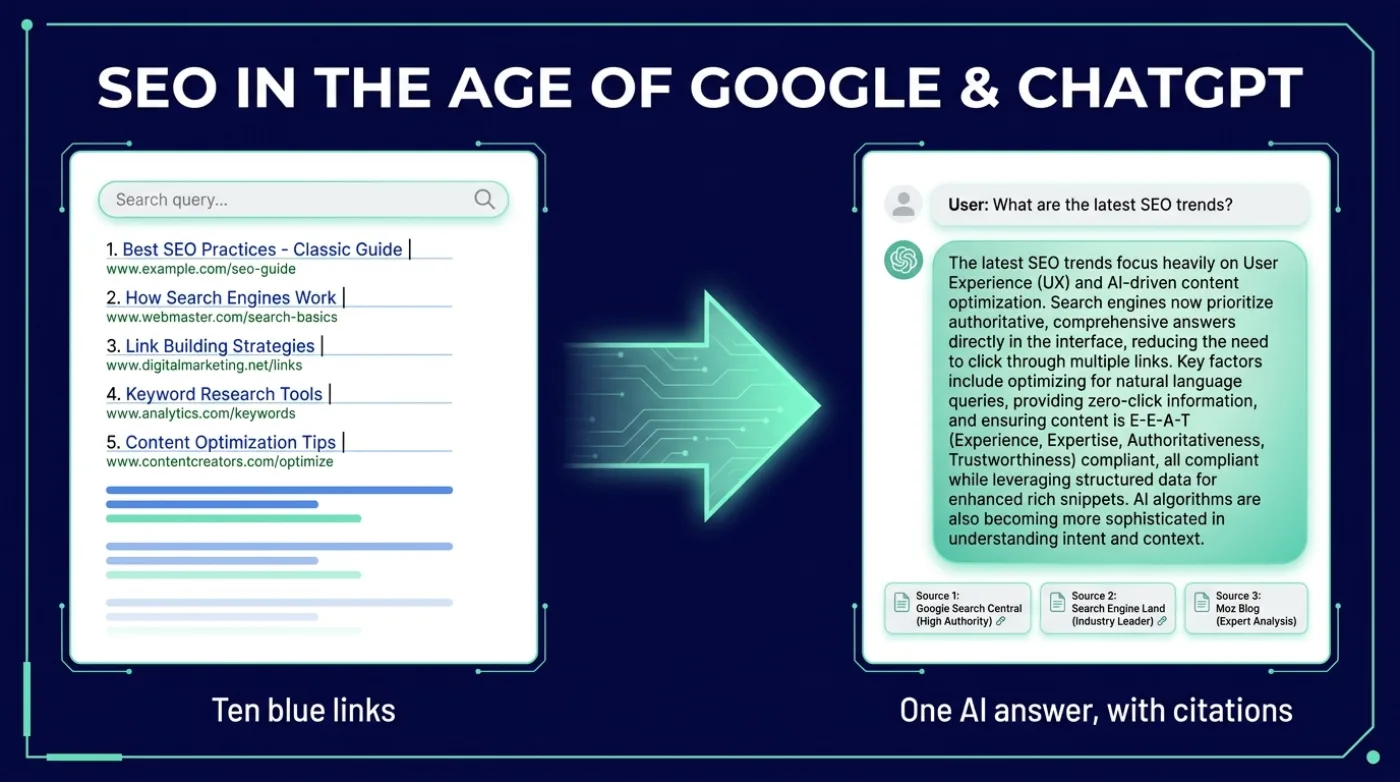
For two decades, SEO meant one thing: earn a spot on the first page of Google. That game is changing. People now ask ChatGPT, Perplexity, and Google's own AI Overviews for answers, and those engines summarize the web instead of just linking to it.
This does not make SEO obsolete. It makes it broader. The same foundations that win on Google also help you get cited inside AI answers.
Why AI engines still rely on classic SEO
Large language models do not invent facts about your business, they retrieve them. When ChatGPT browses the web or Google generates an AI Overview, they pull from pages that are crawlable, well-structured, and trustworthy. Those are the exact qualities technical SEO has always rewarded.
A page that Google cannot crawl is a page no AI engine can cite. A page with no clear structure is hard to summarize. Clean HTML, fast load times, and proper headings are now table stakes for both audiences.
Entities matter more than keywords
Old SEO chased keywords. Modern search understands entities, people, brands, services, and the relationships between them. When your business is described consistently across your site, your structured data, and the wider web, engines build confidence about who you are and what you do.
That confidence is what gets you named in an AI answer instead of a competitor.
What to do now
- Keep your site fast and fully crawlable, render content as real HTML, not JavaScript-only.
- Use clear, descriptive headings that answer real questions.
- Add structured data so engines understand your entity, not just your text.
- Write content that directly answers the questions your customers actually ask.
Go deeper: the full playbook
This post is the short version. If you want the complete framework, the exact moves that get a business mentioned and cited by AI search, read The AI Search Visibility Playbook. It breaks the work into six concrete moves (entity, schema, pillar & cluster, technical, crawler access, and citable content) and includes a self-check you can run on your own site this week.
The shift toward AI answers rewards the same discipline good SEO always demanded: be fast, be clear, and be trustworthy. Do that, and you stay visible, on Google and inside the AI answers that increasingly sit on top of it.
FAQ
How do you rank on ChatGPT?
Give it crawlable, well-structured, trustworthy pages that answer real questions, and make sure you do not block AI crawlers like GPTBot in robots.txt. ChatGPT pulls from pages it can read and trust, so the same technical SEO foundations that win on Google help you get cited. Clear HTML and schema markup make it easier for the model to understand who you are.
Is SEO dead in the age of AI?
No, it is broadening. Search intent has not gone anywhere, and people still need to find businesses and answers. The work that wins is the same discipline good SEO always demanded: be fast, be clear, and be trustworthy, so both Google and AI engines can use your content.
Does structured data help with AI search?
Yes. Schema markup like Organization, Article, and FAQPage tells an engine what your content is, who wrote it, and how it is organized, which makes it easier for AI to understand and cite. It is close to table stakes for AI search now.
How fast can you show up in ChatGPT?
Sometimes within days for a new, well-targeted page, though it varies a lot by topic and competition. The restaurant site I built picked up its first ChatGPT visits within a month of launch, up from zero.